SOLD
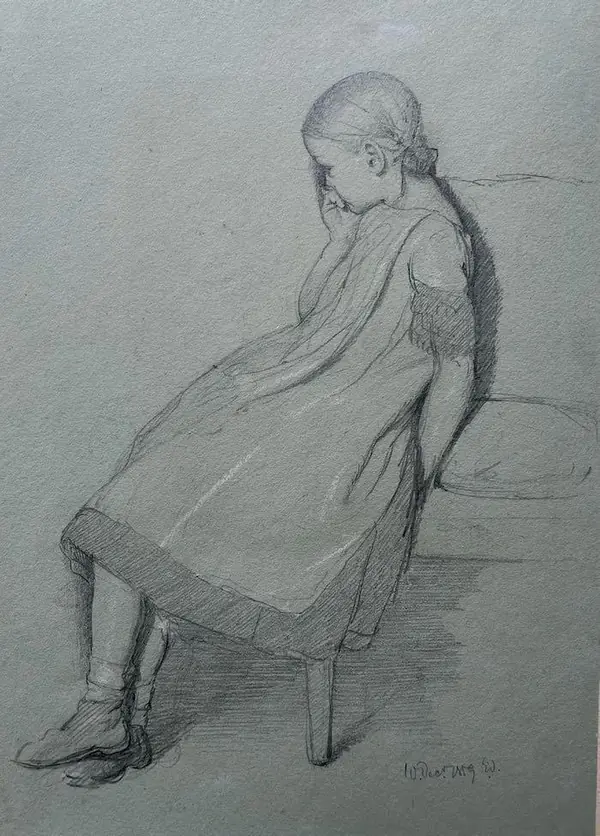
Signed and dated in pen and brown ink: William Strutt/Aug.t.31st./89., pencil
17.8 x 27 cm.; 7 x 10 5/8 inches
Provenance
The Redfern Gallery Ltd. Summer Exhibition, 1955, no. 21; sold to
John Bensusan-Butt, September 7, 1955;
Private collection, U.K. until 2020
Strutt, born in Devon, was from a family of artists. He studied in Paris and made many drawings of animals throughout his career during which he travelled extensively. He visited Australia in 1850, New Zealand in 1856 and returned to England in 1862.
His work is highly prized in the Antipodes and his most famous painting Black Thursday, 6 February. 1851, painted later in 1864, which depicts animals and men fleeing from a bush fire, is one of the treasures of the State Library of Victoria. His work can be found in several other Australian and New Zealand museums and several monographs have been written about his time there.
He was a Fellow of the Zoological Society and he drew animals throughout his career.
You Might Also Like

Signed with initials l.r.: HSM, watercolour over traces of pencil on buff paper heightened with white24 x 9 cm.; 5 ¾ x 3 ¾ inchesFrame size 27 x 18.5 cm.; 9½ x 7 ½ inchesProvenanceThe Fine Art SocietyMarks’ earlier works were usually historical and literary, especially Shakespearian and sometimes humorous. However, he became increasingly interested in painting birds and this body of work was highly praised by John Ruskin. Marks had three exhibitions in six years at the Fine Art Society in London, the first of which was Birds in Bond Street in 1889. He was a frequent visitor to London Zoo where he was frequently approached by other curious visitors . He wrote in his preface to the 1890 catalogue: “The most common remark I hear is, “Ah pretty creature! Don’t he seem to know he’s sitting for his picture?” and concluded “… I hope I may be excused, and not held too eccentric, in preferring to converse with a parrot for one hour, rather than with a politician for two”. The Victoria and Albert Museum have a holding of his work.The artist was born in London, the fourth child of John Isaac Marks, a solicitor. He studied in London at the Royal Academy Schools and later in Paris. He exhibited at the Royal Academy and elsewhere from 1853. He was elected ARA in 1870 and became a full RA in 1878.
View details
John Stanton Ward, CBE, R.A. (1917 – 2006)Still life with a vase of wildflowersSigned in pencil l.r.: John Ward, watercolour over pencil18.7 x 56 cm.; 7 ¼ x 22 inchesProvenancePrivate collection, U.K., until 2026
View details
Watercolour over traces of pencil on Creswick paper31 x 48.3 cm.; 12 ¼ x 19 inchesProvenanceChristie’s, London, the Artist’s sale, 27 May 1850, lot 378;Christie's London, April 25, 1995, 116;Bill Thomson, Albany Gallery until 2021De Wint first visited Shropshire in 1829-1830 and exhibited a number of Shropshire views throughout his career. He had two major patrons there, Lord Clive at Oakley Park near Ludlow, not far from the Clee Hills, and Edward Cheney of Badger Hall.
View details
Inscribed verso: Primrose Hill coloured on the spot by/Girtin, watercolour over pencil on oatmeal paper.19.7 x 48.7 cm.; 7 ¾ x 19 inchesProvenanceArthur Boney, his sale, Sotheby’s, 7 October 1947, lot 34, bought by P. & D. Colnaghi & Co. , London;Ray Livingston Murphy (1923-1953), New York, by 1950, his sale, Christie’s, 19 November 1985, lot 35; Robert Tear, OBE (1939-2011), his sale, Sotheby’s, 9 July 2014, lot 189;With Guy Peppiatt Fine Art;Private collection, U.K. until 2024LiteratureT. Girtin and D. Loshak, The Art of Thomas Girtin, 1954, no. 416, p. 191;G. Smith, Thomas Girtin (1775-1802): An Online CatalogueArchive and Introduction to the Artist, TG1761ExhibitedNew Haven, Yale University Art Gallery, Prospects, 1950, no. 18., pl. 9b;Guy Peppiatt Fine Art, London, British Drawings and Watercolours, 2015, no. 17This panoramic landscape has been identified as showing Primrose Hill in north London, on the basis of an inscription on the back of the drawing, and Thomas Girtin (1874–1960) and David Loshak consequently dated it to 1800–1801. The area was then undeveloped. It did not become a place of leisure and recreation until well into the nineteenth century, since when the rapid expansion of the city northwards changed the appearance of the landscape so greatly that it may never be possible to confirm the identification of the view with certainty.The work may well have been coloured on the spot, as the inscription suggests, as it is worked in a limited palette without much foreground detail.
View details
Samuel Palmer, RWS (1805-1881)La Vocotella near Corpo di Cava, ItalyPencil and watercolour heightened with bodycolour with scratching out 26.7 x 37.8 cm.; 10 ½ x 14 7/8 inchesProvenanceWith Agnew’s, London 2002, no. 53Anonymous sale Sotheby’s, London, 23 November 2006, lot 145;W/S Fine Art, ‘Andrew Wyld: Connoisseur Dealer’, Christie’s, London, 10 July 2012, lot 147;Timothy Clowes, his sale at Sotheby’s, London, 23 September 2021, lot 148;Where bought by a private collector until 2026Samuel and Hannah Palmer stayed at a small inn at Corpo di Cava on their Italian honeymoon in the summer of 1838. The inn overlooked a Benedictine monastery and a ravine. During this very happy period of his life, Palmer produced some of his finest watercolours, which combined the mysticism of his Shoreham work with more Italianate composition and structure. He told his friend George Richmond that it was here that he felt he was ‘no longer a mere maker of sketches, but an artist’ (E. Malins Samuel Palmer’s Italian Honeymoon, 1968, p. 73).This watercolour is constructed on classical lines with the receding serpentine path with a figure and is infused with the golden glow of Italian sunlight.A similar watercolour of the same place from a different viewpoint is in the collection of the Graves Art Gallery Sheffield (see R. Lister Catalogue Raisonné of the works of Samuel Palmer, 1988, no. 311, pp. 126-7, ill.). In a letter to her parents, written during August 1838, Hannah Palmer mentioned two views of Corpo di Cava by her husband. Presumably one is the Graves Art Gallery drawing and the present work may be the second which Raymond Lister records as untraced (R. Lister, Catalogue Raisonné of the Works of Samuel Palmer, Cambridge 1988, see no. 310).
View details
Signed with monogram l.r., inscribed l.l.: near Calikut., watercolour heightened with touches of bodycolourProvenanceFranklin Lushington (1823-1901) and thence by descentLear was invited to India by his friend and patron Lord Northbrook who was appointed Viceroy in 1871, and his journey there was the last and longest of his life. He was overwhelmed by the colour and vitality of India and enjoyed the bustle of Viceregal life.Calicut, or present-day Kozhikode, is on the Malabar coast in Kerala and was a centre of the Indian spice trade. Edward Lear arrived there in October 1874, just as the monsoon began. He was warned about the dangers of contracting fever but stayed, despite the pouring rain, until the skies were clear enough to draw. He described the roads around the city as “of such redundant beauty one can hardly dream.” Franklin Lushington, Lear’s close friend and first owner of this drawing, was the son of Edmund Henry Lushington. He was appointed judge to the Supreme Court of Justice in the Ionian Islands in 1855 and Lear went with him to live in Corfu. They first met in Malta in 1849, where Franklin’s elder brother Henry was Chief Secretary to the government. On his death, Lear left all his papers to Lushington, who later destroyed most of them.
View details
Sir Gerald Festus Kelly, P.R.A. (British 1879-1972)The Great Wall of ChinaOil on boardExhibitedMartyn Gregory Gallery, ‘Modern British Painters’, October 1988, Catalogue no. 52, no. 34This is a study for a painting of the same size of the Great Wall of China exhibited at the Royal Hibernian Academy, 1938, no.45 and the Royal Academy, London, Exhibition of Works by Sir Gerald Kelly, 1957, no.231.Born in London of Irish descent, Kelly was educated at Cambridge University, later living and studying art in Paris where he met Degas, Monet, Renoir and Sickert. Whistler was also an early influence as were Cézanne and Gaugin. Kelly was an enthusiastic traveller, visiting amongst other countries China, Spain, America, South Africa and Burma, where he painted some of his most characteristic and charming figure studies. He became a successful society portraitist whose sitters included Somerset Maugham, whom he painted several times, and he undertook numerous state portraits. Kelly is represented in many public collections, including the Tate, which holds seven works. He had retrospective exhibitions at the Leicester Galleries in 1950 and in 1957 at the RA. He was elected RA in 1930, was the Academy's Keeper from 1943-45 and President, defeating Augustus John in the election, from 1949-54. Kelly held a number of official positions, such as membership of the Royal Fine Arts Commission, 1938-43, and was knighted in 1945. Between 1909 and 1970 Kelly exhibited over 300 works at the RA. During his lifetime his work became well known through popular prints.
View details
Signed and dated l.r.: W. Callow.1833, watercolour over traces of pencil with scratching outProvenancePrivate collection U.K. until 2026This fine example of Callow’s work dates from the time he was sharing a studio in Paris with Thomas Shotter Boys at 19 Rue de Bouloi near the Louvre. He visited England during the summer and presumably travelled through Dover.
View details£2,250

Signed l.r.: W HUNT, watercolour with bodycolour on artist’s board16 x 20.3 cm; 6 1/4 x 8 inchesPrimroses were a favourite subject of Hunt’s, and one which he frequently exhibited in the 1840s and 1850s.Hunt was born with a deformation of his legs which restricted his movement and he worked mainly from the studio, as painting outside was difficult for him. He specialised in carefully drawn smale-scale still lifes like this one as a result and pioneered new techniques of watercolour, using stipple techniques in subtle colour combinations and achieving a brightness of colour by overlaying washes over white gouache.
View details
Signed with initials l.r.: HBB, watercolour and bodycolour over pencil, inscribed verso: Siracuse and stamped with collector’s markProvenanceGilbert Davis (L. 757a.);Edward Seago, his estate sale at Christie’s, London 1 March 1977, lot 94;Where bought by B.M. Williams;Christie’s, London, 21 November 2007, lot 145, where acquired by the previous owner until 2025 Gilbert Davis (1899–1983) built up a large collection of watercolours in the middle of the twentieth century. He sold the bulk of his collection in 1959 to the Huntingdon Library and Botanical Gardens in San Marino, California. Edward Seago RBA, RWS (1910-1974) was one of the most popular British artists of 20th century, who painted in oils and watercolours.
View details