
Watercolour over pencil with scratching out18.2 x 22.8 cm.; 7 ¼ x 9 1/8 inches
Provenance
Quentin and Molly Bridge until 2020
Exhibited
Martyn Gregory, British Watercolours & Drawings, 2020, no. 8
This charming early drawing by Cox dates to circa 1815. A woman and a child can be seen collecting water in a bucket from a stream near a wooden bridge by a cottage. The child appears to be wearing a black Welsh hat.
You Might Also Like
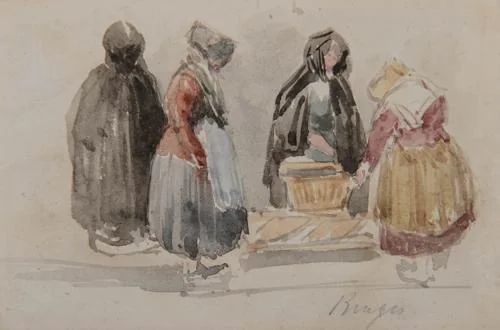
Inscribed l.r.: Bruges, watercolour7.6 x 11.4 cm; 3 x 4½ inchesProvenanceSpink & Son Ltd, London, K3/1890b, part of a group purchased from Appleby Brothers, 2 August 1960.This spontaneous, on-the-spot sketch was presumably done when Cox visited Bruges in 1826. His first trip to the Continent was organised by his brother-in-law Mr Gardener, an agent for the sale of government ordnance maps who had premises at 163 Regent Street, London. Gardener persuaded Cox and his son David Cox Jr to accompany him on a business trip to Brussels. The party travelled from Dover to Calais and then, travelling by diligence, on to Dunkerque, Bruges and Brussels. Cox evidently liked the caps worn by the market women in Belgium as he sketched them again in Brussels.1 1.See N. Neil Solly, Memoir of the Life of David Cox, 1873, reprinted 1973, p. 49.
View details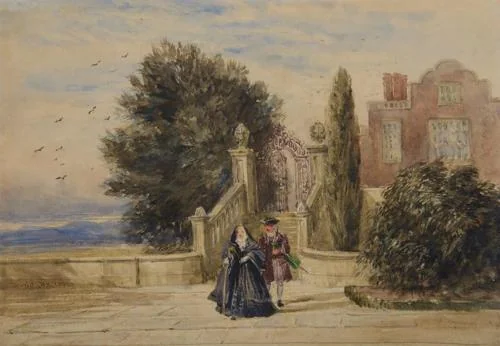
Signed and dated l.l.: David Cox. 1836, watercolour over pencil with scratching out18 x 26 cmIn the summer of 1836 Cox spent a few weeks at Rowsley, painting at Haddon Hall. He made several watercolours of elegant figures in seventeenth century costume strolling on the terrace there to which the present work relates. Although the present work does not appear to be of Haddon, it fits in with this period of his oeuvre.
View details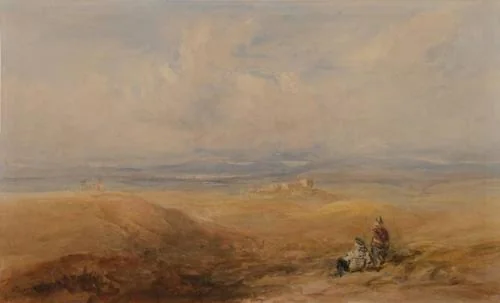
Signed l.l.: David Cox., watercolour over traces of pencil with touches of pen and black ink on buff paper29.6 x 39 cm; 11 ¾ x 15 ⅜ inchesProvenance: Agnew’s, London, 126th annual exhibition, March 1999, no. 63; The Flannery collection, UK, and by descent until 2018.This very freely drawn watercolour represents a transitional stage in the development of the important theme of ‘Peace and War’, one of David Cox’s major subjects. Two local men, one seated, one standing, watch a small troop of soldiers on the march in an extensive sweeping landscape under a huge sky, with Lancaster Castle in the middle distance and the waters of Morecambe Bay beyond. Unusually for Cox there is not much pencil underdrawing.Cox’s preoccupation with military activity during the very unsettled years of the 1830s and 1840s manifests itself after his 1838 trip with his wife to Seabrook, near Hythe in Kent, for six weeks. The artist made sketching trips along the coast of Kent, including one to Lympne, five miles from Hythe, resulting in Peace and War: Lympne Castle ( c. 1838, Birmingham Museums & Art Gallery).The present work, which is similar in style and feel to the Lympne watercolour, presumably dates from the same time, but shows the composition reversed and the distant focus of Lancaster Castle as in Lancaster: Peace and War, 1842 (Art Institute of Chicago). Most of Cox’s numerous ‘Peace and War’ subjects are set at Lancaster rather than Lympne and have more developed references to ‘War’ than the small troop of riders seen here on the top of the hill on the left.The theme is repeatedly treated by Cox at this period, resulting in his 1838 exhibits at the Society of Painters in Water-colours in London, Rocky Scene – Infantry on the March and Stirling Castle – Cavalry on the March and the 1839 Cavalry on the March. In 1848 the first work to be entitled Peace and War (Lady Lever Art Gallery, Port Sunlight, National Museums Liverpool) was exhibited at the Society of Painters in Water-colours.
View details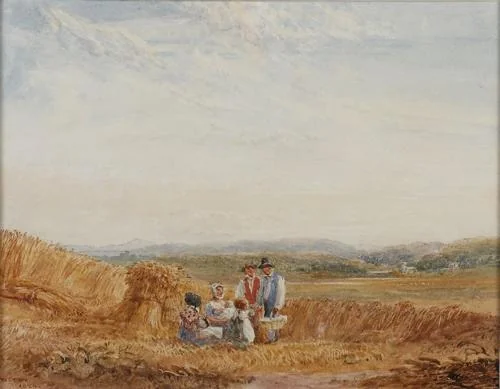
KT587Signed and dated l.l.: D. Cox/1824, watercolour over pencil22.6 x 28.9 cm.; 8 ¾ x 11 3/8 inchesProvenanceColnaghi (exhibited as ‘In the Wye Valley’);Viscount Eccles (1905-1994);Abbott and Holder; from where acquired byPeter Roberts until 2023ExhibitedProbably the Society of Painters in Water-Colours, 1824, no. 289, Hay Field – View near HerefordThis charming watercolour is a fine example of the fluent small-scale drawings with which Cox had commercial success in the mid to late 1820s.He wrote to William Radclyffe that he intended to devote more time to saleable smaller works, as his larger pictures were not finding buyers (Scott Wilcox points out that his discovery of the elegant small watercolours by Bonington at this date would have provided a compelling model (See Scott Wilcox, ed., Sun, Wind, and Rain: The Art of David Cox, exhibition catalogue, Yale Centre for British Art, p. 36).The castellated church in in middle distance may well be modelled on St Peter’s, Lugwardine. The building to the right of the church bears a passing resemblance to Sufton Court (which is not so close to the church). Cox was an artist, not a topographer, and frequently modified landscapes and landmarks to suit his artistic vision.Viscount (David) Eccles (1905-1994) had a fine collection of 18th and 19th century British drawings. He was a politician who organised the coronation of Queen Elizabeth II. After being sacked by Harold Macmillan in July 1962 he went back into business, first as a director of Courtaulds and later as chairman of West Cumberland Silk Mills.Peter Roberts was a school master and collector of English watercolours who taught English at Oundle School until his retirement in 2007.
View details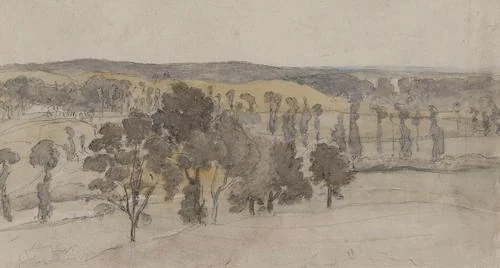
Watercolour over pencil20.5 x 38 cm.; 8 1/8 x 15 inchesProvenanceWalter Coleridge Richmond (1852-1931), the son of the artist, by descent;With Radnorshire Fine ArtRichmond continued to draw and paint landscapes throughout his successful career as a portraitist. These works remained private and stayed mainly in his family. This beautiful sketch has a directness which reflects his enjoyment of the opportunity for contemplation when drawing from nature.
View details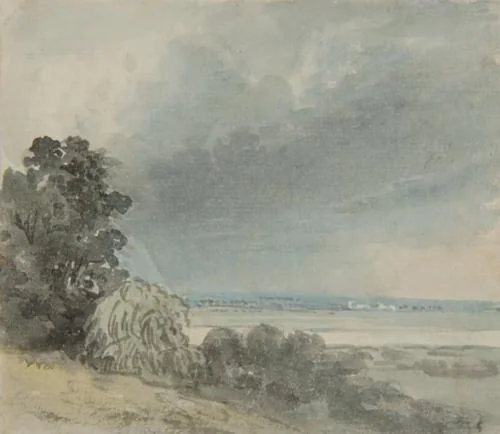
Watercolour, with a pencil sketch of a house in a landscape verso, on laid paper11.2 x 13 cmProvenance: William Arnold Sandby; John Manning, London; Private collection, UK until 2017William Arnold Sandby (c. 1828-1904) was the great-grandson of Thomas Sandby, author of the first book about the artists, Thomas and Paul Sandby-Royal Academicians, 1892, and the historian of the Royal Academy (two volumes of its history published in 1862). He had a large collection of the work of his forebears, helped organise their first exhibition at Nottingham Castle Museum in 1884 and bequeathed many of their works to museum collections.
View details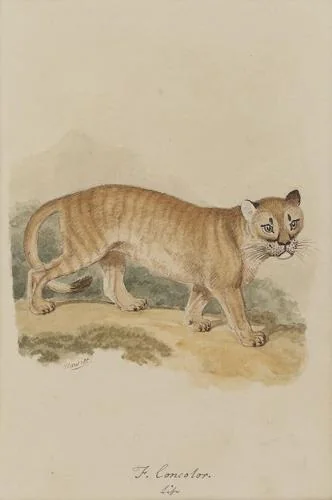
Two, each signed l.l.and l.r., each inscribed l.c.: F. Concolr./life and F. Ocelot.of.Albany./Life, watercolour over pencilEach approx. 25 x 17.5 cm.; 9 ¾ x 6 7/8 inchesThe artist was self-taught and specialised in drawings of animals and field sports.From a wealthy Quaker family, Howitt took up art professionally when he encountered financial difficulties and became a drawing master in Ealing.He married Thomas Rowlandson's sister Elizabeth in 1779 and was part of Rowlandson's circle together with George Morland, Henry Wigstead and J.R. Smith.
View details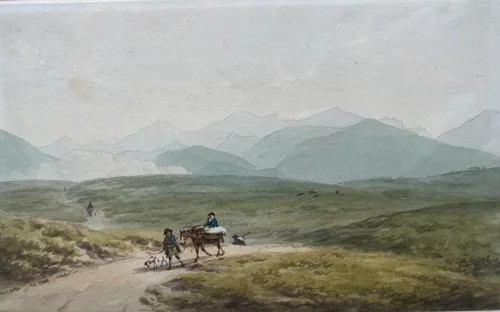
Inscribed on original label now attached to backboard: General Distant View of the Carnarvonshire Mountains, seen from the road beyond Llangerniew,/going by the Vale of the Elwyn from St Asaph to Llanrwst-Principal in this Towering Group, are Moel Siabod, Snowdon, The Glyders/ and Trevaon Denbighshire, watercolour over pencil.13 x 20.8 cm.; 5 1/8 x 8 ¼ inchesProvenanceGeorge Greville, 2nd Earl of Warwick (1746-1816), no. 17, part of an album sold at Sotheby’s, 17 June 1936;With Leger Galleries, 1980; Christie’s, London, 20 November 1984, lot 113, where bought by a private collector, until 2024Smith seems to have been fascinated by the Welsh countryside and dated drawings, often inscribed ‘taken on the spot’, point to visits nearly every year from 1784-1798, after his return from Italy.The artist was born in Cumberland and patronised by 2nd Earl of Warwick who sponsored his travels to Italy in 1776 and whose name became the artist’s sobriquet. Smith spent five years in Rome and Naples, befriending William Pars and Thomas Jones, in whose Memoirs he is frequently referenced. He travelled home in 1781 through Switzerland with Francis Towne and was among the most admired watercolourists of his day.
View details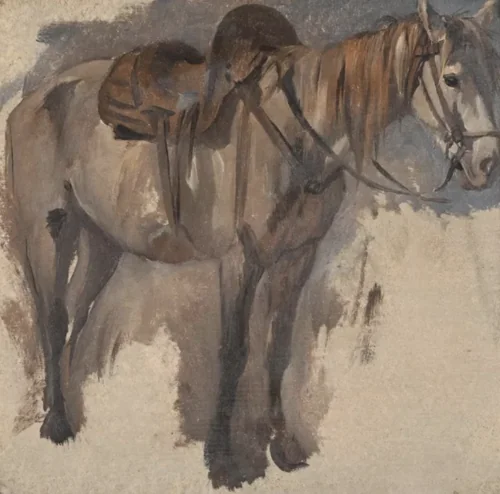
Oil on paper laid down on board, inscribed on reverse of board: George Mason ARA and stamped with a Christie’s stencil21 x 21 cm.; 8 ¼ x 8 ¼ inchesProvenanceThe artist’s studio sale, Christie’s, 15 February 1873, lot 91, where bought byGeorge Dunlop Leslie, RA (1835-1921); his daughter Lydia Leslie, By descent to T. L. Twidell ExhibitedStoke-on-Trent Museum & Art Gallery, George Heming Mason, 1982, cat. no 20 (ill) (lent by T.W. Twidell). ExhibitedGeorge Heming Mason, City Museum & Art Gallery, Stoke-on-Trent, 1 May – 12 June 1982; Walker Art Gallery, Liverpool, 26 June – 31 July, The Fine Art Society, London 9 August – 4 September, cat. 20 (ill.)The sympathetic white horse is yoked in the Italian manner in this lively oil sketch and can be presumed to have been executed in Italy.
View details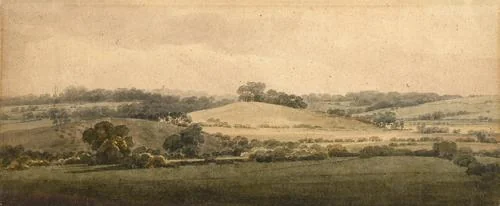
Inscribed verso: Primrose Hill coloured on the spot by/Girtin, watercolour over pencil on oatmeal paper.19.7 x 48.7 cm.; 7 ¾ x 19 inchesProvenanceArthur Boney, his sale, Sotheby’s, 7 October 1947, lot 34, bought by P. & D. Colnaghi & Co. , London;Ray Livingston Murphy (1923-1953), New York, by 1950, his sale, Christie’s, 19 November 1985, lot 35; Robert Tear, OBE (1939-2011), his sale, Sotheby’s, 9 July 2014, lot 189;With Guy Peppiatt Fine Art;Private collection, U.K. until 2024LiteratureT. Girtin and D. Loshak, The Art of Thomas Girtin, 1954, no. 416, p. 191;G. Smith, Thomas Girtin (1775-1802): An Online CatalogueArchive and Introduction to the Artist, TG1761ExhibitedNew Haven, Yale University Art Gallery, Prospects, 1950, no. 18., pl. 9b;Guy Peppiatt Fine Art, London, British Drawings and Watercolours, 2015, no. 17This panoramic landscape has been identified as showing Primrose Hill in north London, on the basis of an inscription on the back of the drawing, and Thomas Girtin (1874–1960) and David Loshak consequently dated it to 1800–1801. The area was then undeveloped. It did not become a place of leisure and recreation until well into the nineteenth century, since when the rapid expansion of the city northwards changed the appearance of the landscape so greatly that it may never be possible to confirm the identification of the view with certainty.The work may well have been coloured on the spot, as the inscription suggests, as it is worked in a limited palette without much foreground detail.
View details