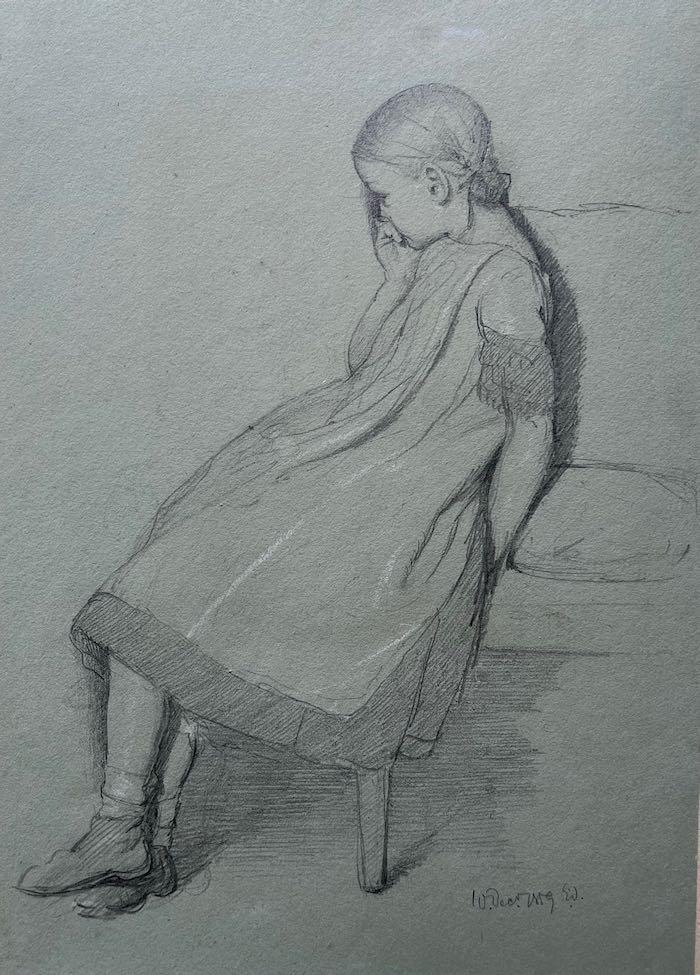

Signed l.r.: C. Bentley, watercolour over traces of pencil
Provenance
L.G. Duke; Spink & Son. Ltd.
You Might Also Like
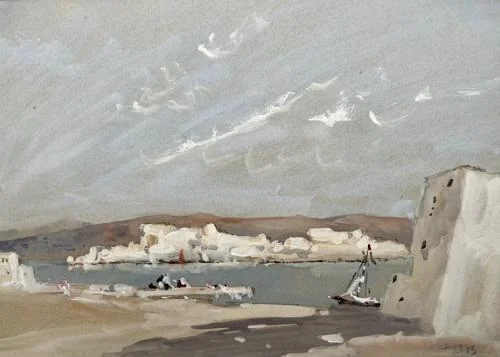
Signed with initials l.r.: HBB, watercolour and bodycolour over pencil, inscribed verso: Siracuse and stamped with collector’s markProvenanceGilbert Davis (L. 757a.);Edward Seago, his estate sale at Christie’s, London 1 March 1977, lot 94;Where bought by B.M. Williams;Christie’s, London, 21 November 2007, lot 145, where acquired by the previous owner until 2025 Gilbert Davis (1899–1983) built up a large collection of watercolours in the middle of the twentieth century. He sold the bulk of his collection in 1959 to the Huntingdon Library and Botanical Gardens in San Marino, California. Edward Seago RBA, RWS (1910-1974) was one of the most popular British artists of 20th century, who painted in oils and watercolours.
View details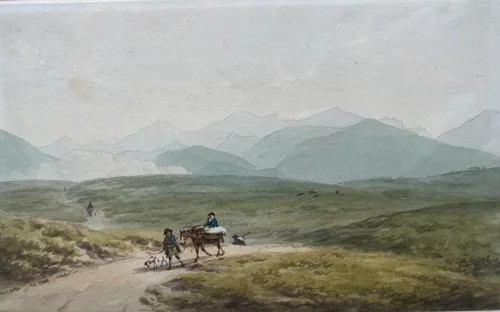
Inscribed on original label now attached to backboard: General Distant View of the Carnarvonshire Mountains, seen from the road beyond Llangerniew,/going by the Vale of the Elwyn from St Asaph to Llanrwst-Principal in this Towering Group, are Moel Siabod, Snowdon, The Glyders/ and Trevaon Denbighshire, watercolour over pencil.13 x 20.8 cm.; 5 1/8 x 8 ¼ inchesProvenanceGeorge Greville, 2nd Earl of Warwick (1746-1816), no. 17, part of an album sold at Sotheby’s, 17 June 1936;With Leger Galleries, 1980; Christie’s, London, 20 November 1984, lot 113, where bought by a private collector, until 2024Smith seems to have been fascinated by the Welsh countryside and dated drawings, often inscribed ‘taken on the spot’, point to visits nearly every year from 1784-1798, after his return from Italy.The artist was born in Cumberland and patronised by 2nd Earl of Warwick who sponsored his travels to Italy in 1776 and whose name became the artist’s sobriquet. Smith spent five years in Rome and Naples, befriending William Pars and Thomas Jones, in whose Memoirs he is frequently referenced. He travelled home in 1781 through Switzerland with Francis Towne and was among the most admired watercolourists of his day.
View details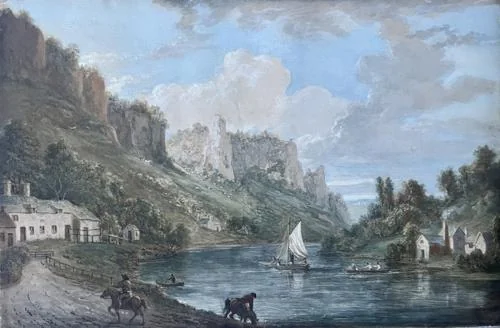
ABPPaul Sandby, R.A. (1731- 1809)The River Wye at New Weir, HerefordshireSigned in brushpoint l.l.: P Sandby RA, watercolour and bodycolour, with old labels attached to backboard (illegible)ProvenanceThe Fine Art Society, London;Private collection, U.K.The Longstone can be seen prominently on the left of the composition above the Wye where fishermen and rowers are enjoying the river. Sandby includes the busy iron manufactory on the opposite bank. Many of the tourists who flocked to the river Wye to enjoy its picturesque scenery and to climb Yat Rock also included a visit to the forge, and images of this stretch of the river often include depictions of the lime kilns, stone quarries, and iron and tin works that dotted its banks. Paul Sandby and his brother Thomas (1717-1798) began their careers making maps and military drawings in Scotland. Founder members of the Royal Academy in 1768, they both taught in military establishments and Paul was recognised as the leading topographical artist of his time. The artist toured South Wales with Sir Joseph Banks and others in 1773 which resulted in his series of aquatints of published in 1775-1776. His detailed watercolours of the picturesque landscape and the popular prints fuelled the nascent tourism attracting visitors to the Wye Valley.
View details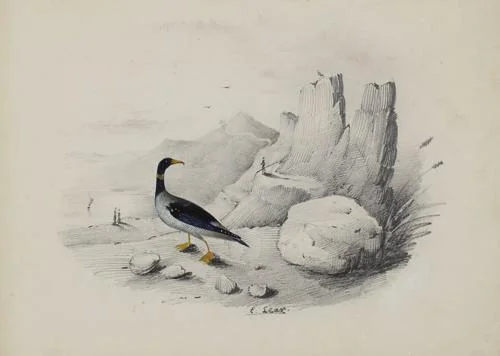
Signed l.c.: E. Lear, pencil with watercolour, pen and black ink and touches of gold17.7 x 23 cm.; 7 x 9 inchesThese charming, quirky drawings are characteristic early works by Lear, dating from the late 1820s or early 1830s when he was establishing himself as an ornithological artist. They relate to a group of drawings which Lear gave to Mrs Godfrey Wentworth, who supported his employment by the Zoological Society in 1831, and whom he credited with launching him as an artist. They are imaginary, fanciful subjects drawn with not a little humour, resembling the stylised watercolours of birds painted on late eighteenth century porcelain. Robert McCracken Peck has made the interesting suggestion that Lear and his sister Ann may have been thinking of approaching ceramics companies with them (see Robert McCracken Peck, The Natural History of Edward Lear, 2016, pp. 27-9).Two surviving family albums from the late 1820s, containing a mixture of similar natural history subjects by Edward Lear and his sisters Ann and Sarah, are in the collection of the Houghton Library, Harvard University (MS Typ 55.4 and 55.27).Sir Edward Strachey was a man of letters and friend of Lear’s, who wrote an introduction to Nonsense Songs in 1895. He lived at Sutton Court, Chew Magna in Somerset and was a neighbour of Lear’s close friend Chichester Fortescue, the Liberal politician whom Lear first met in Rome in 1845.
View details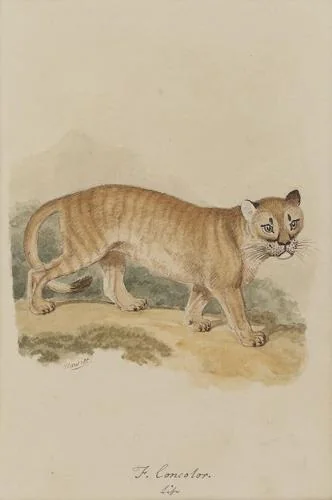
Two, each signed l.l.and l.r., each inscribed l.c.: F. Concolr./life and F. Ocelot.of.Albany./Life, watercolour over pencilEach approx. 25 x 17.5 cm.; 9 ¾ x 6 7/8 inchesThe artist was self-taught and specialised in drawings of animals and field sports.From a wealthy Quaker family, Howitt took up art professionally when he encountered financial difficulties and became a drawing master in Ealing.He married Thomas Rowlandson's sister Elizabeth in 1779 and was part of Rowlandson's circle together with George Morland, Henry Wigstead and J.R. Smith.
View details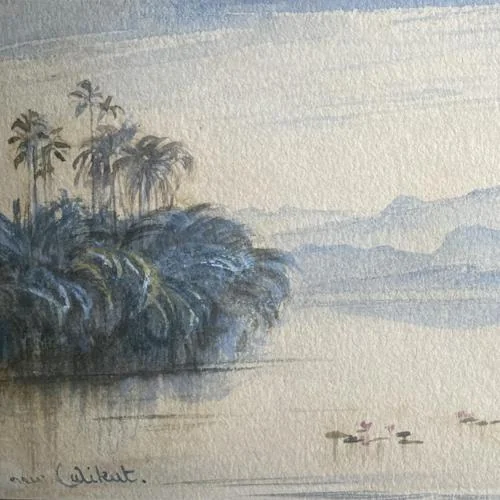
Signed with monogram l.r., inscribed l.l.: near Calikut., watercolour heightened with touches of bodycolourProvenanceFranklin Lushington (1823-1901) and thence by descentLear was invited to India by his friend and patron Lord Northbrook who was appointed Viceroy in 1871, and his journey there was the last and longest of his life. He was overwhelmed by the colour and vitality of India and enjoyed the bustle of Viceregal life.Calicut, or present-day Kozhikode, is on the Malabar coast in Kerala and was a centre of the Indian spice trade. Edward Lear arrived there in October 1874, just as the monsoon began. He was warned about the dangers of contracting fever but stayed, despite the pouring rain, until the skies were clear enough to draw. He described the roads around the city as “of such redundant beauty one can hardly dream.” Franklin Lushington, Lear’s close friend and first owner of this drawing, was the son of Edmund Henry Lushington. He was appointed judge to the Supreme Court of Justice in the Ionian Islands in 1855 and Lear went with him to live in Corfu. They first met in Malta in 1849, where Franklin’s elder brother Henry was Chief Secretary to the government. On his death, Lear left all his papers to Lushington, who later destroyed most of them.
View details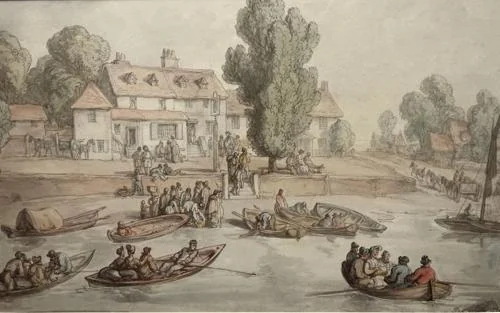
Pen and brown and grey ink and watercolour over traces of pencil, bears inscription and date22 x 36 cm.’ 8 ½ x 14 1/8 inchesProvenanceMaurice Dear, Southampton;Private collection, U.K., until 2025Rowlandson drew boating scenes such as this one on many occasions, this work probably dates from c. 1810-1820. The river is teeming with a variety of craft and passengers and the nearby pub doing a roaring trade.
View details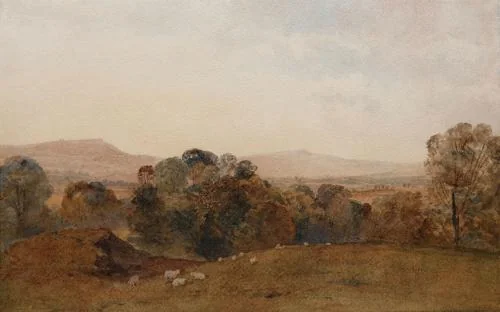
Watercolour over traces of pencil on Creswick paper31 x 48.3 cm.; 12 ¼ x 19 inchesProvenanceChristie’s, London, the Artist’s sale, 27 May 1850, lot 378;Christie's London, April 25, 1995, 116;Bill Thomson, Albany Gallery until 2021De Wint first visited Shropshire in 1829-1830 and exhibited a number of Shropshire views throughout his career. He had two major patrons there, Lord Clive at Oakley Park near Ludlow, not far from the Clee Hills, and Edward Cheney of Badger Hall.
View details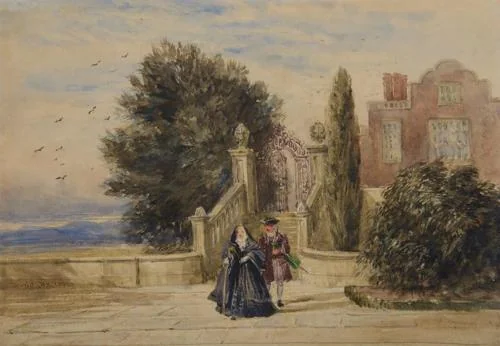
Signed and dated l.l.: David Cox. 1836, watercolour over pencil with scratching out18 x 26 cmIn the summer of 1836 Cox spent a few weeks at Rowsley, painting at Haddon Hall. He made several watercolours of elegant figures in seventeenth century costume strolling on the terrace there to which the present work relates. Although the present work does not appear to be of Haddon, it fits in with this period of his oeuvre.
View details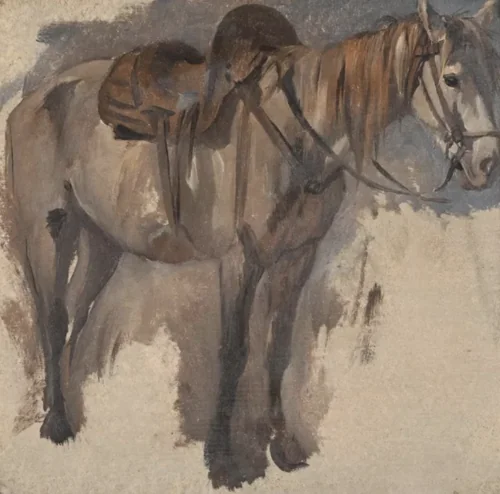
Oil on paper laid down on board, inscribed on reverse of board: George Mason ARA and stamped with a Christie’s stencil21 x 21 cm.; 8 ¼ x 8 ¼ inchesProvenanceThe artist’s studio sale, Christie’s, 15 February 1873, lot 91, where bought byGeorge Dunlop Leslie, RA (1835-1921); his daughter Lydia Leslie, By descent to T. L. Twidell ExhibitedStoke-on-Trent Museum & Art Gallery, George Heming Mason, 1982, cat. no 20 (ill) (lent by T.W. Twidell). ExhibitedGeorge Heming Mason, City Museum & Art Gallery, Stoke-on-Trent, 1 May – 12 June 1982; Walker Art Gallery, Liverpool, 26 June – 31 July, The Fine Art Society, London 9 August – 4 September, cat. 20 (ill.)The sympathetic white horse is yoked in the Italian manner in this lively oil sketch and can be presumed to have been executed in Italy.
View details